Spotify makes audiobooks easy to try. Audible still gives frequent listeners more control, fewer limits, and a setup built for people who treat audiobooks like actual books.
Audible is better if you listen often, want to keep the books you buy with credits, and prefer an app designed around audiobooks. Spotify is better if you already pay for Premium and want casual audiobook access without adding another app to your life.
The tricky part is that both platforms sound similar from a distance. They both offer audiobooks. They both live on your phone. They both make it very easy to tell yourself that buying another book is technically personal growth.
But the difference shows up fast once you look at listening limits, ownership, catalog access, and how often you actually finish the books you start.
Audible vs Spotify at a Glance
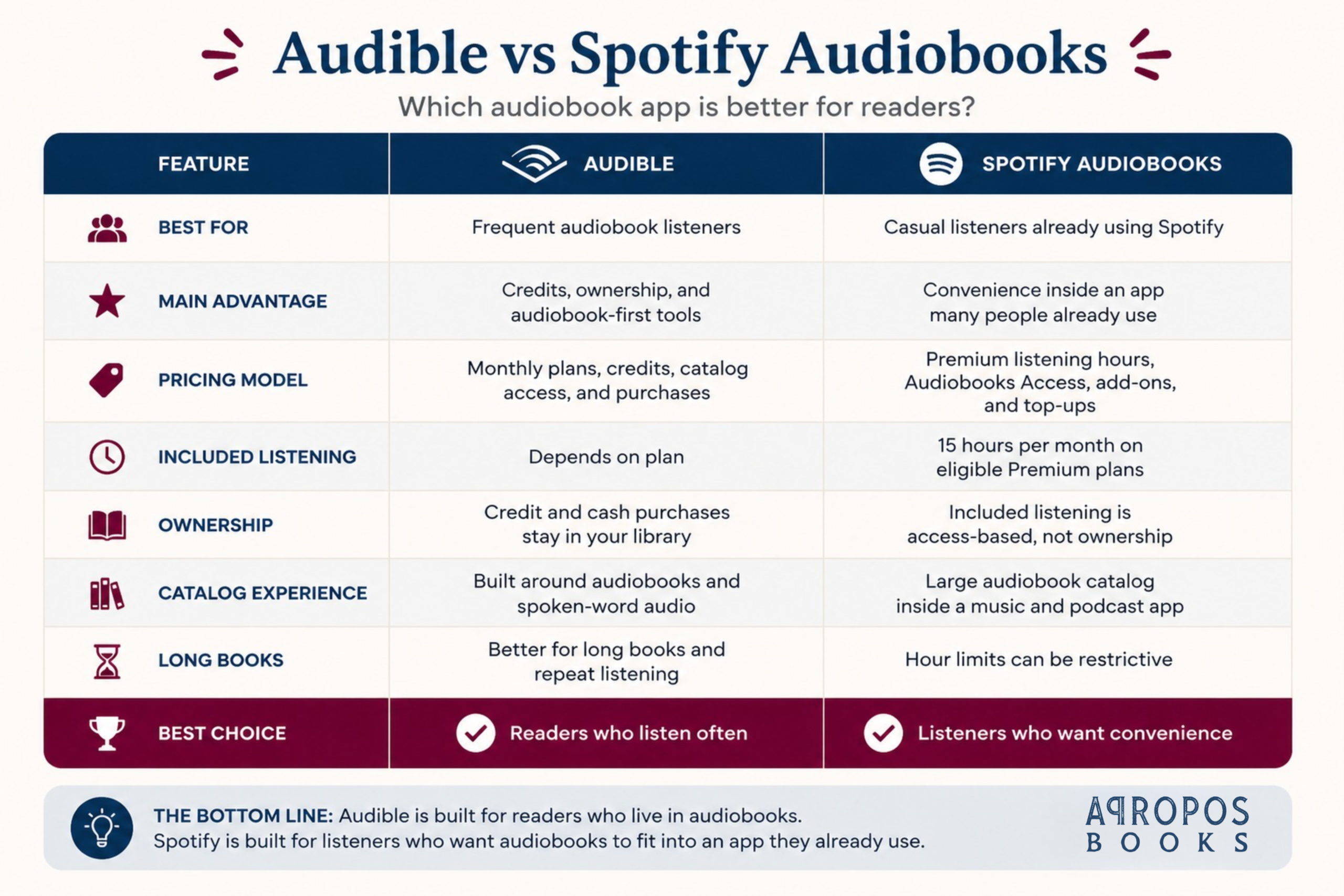
The Short Verdict
Audible is the stronger choice if audiobooks are already part of your reading life. It gives regular listeners a more focused audiobook experience, especially if you like long books, want to build a library, or prefer choosing one full title at a time without watching the clock.
Spotify is a good option if audiobooks are more of a bonus. If you already use Spotify Premium for music and podcasts, the included audiobook hours can be useful for sampling books, trying shorter titles, or listening casually between playlists.
The real question is not which app is better in the abstract. It is how you actually listen.
If you finish audiobooks regularly, Audible makes more sense. If you want audiobooks tucked into an app you already use, Spotify is convenient.
How Audible Works for Audiobook Listeners
Audible is built around audiobooks first. That matters.
The app is designed for browsing books, saving titles, managing a library, adjusting narration speed, setting sleep timers, and returning to long listens without feeling like your book is competing with your workout playlist.
Audible’s plans have shifted over time, so it is important to look at the current options before assuming it works the same way it did a few years ago. Audible now offers plans that include access to selected titles, catalog listening, member pricing, and, on Premium plans, credits that can be used to purchase audiobooks.
The biggest advantage is still ownership through credits and cash purchases. If you buy an audiobook with an Audible Premium credit, it stays in your library even if you cancel later. That makes Audible feel more like building a book collection than renting time with a title before the month resets.
For readers who listen every month, revisit favorites, or regularly pick up long fantasy, romance, thriller, sci-fi, or nonfiction titles, that library model is a big deal.
It also helps if you are particular about browsing. Audible is not perfect, because no app has yet solved the ancient reader problem of “I know exactly what I want until someone asks.” But it is still built around books in a way Spotify is not.
How Spotify Audiobooks Work
Spotify’s biggest strength is convenience.
If you already use Spotify for music or podcasts, adding audiobooks feels easy. You do not need to learn a new app, rebuild another library, or remember another login that you absolutely swore you saved somewhere.
Eligible Spotify Premium plans include 15 hours of audiobook listening each month from Spotify’s audiobook subscriber catalog. Spotify says Premium users can listen from a catalog of over 700,000 audiobook titles, and users can add more time through add-ons or top-ups when they run out.
That makes Spotify a strong option for casual listeners. It is especially useful if you want to test audiobooks, listen to shorter books, or add the occasional title between music and podcasts.
The catch is the hour limit.
Audiobooks are not always short. A single fantasy novel can laugh at 15 hours and keep walking. Some nonfiction books, historical sagas, sci-fi epics, and romance series entries can also stretch past the included monthly time.
Spotify also offers an Audiobooks Access plan in the U.S., which gives listeners 15 monthly hours from the audiobook subscriber catalog. That plan does not include the usual Spotify Premium music features, and unused listening time expires each month.
So Spotify can absolutely work for audiobooks. It just works best when you understand that the model is based on listening time, not owning full books.
Audible vs Spotify Pricing
Pricing depends on how you listen.
Spotify may feel cheaper because many listeners already pay for Premium. If the subscription is already part of your monthly budget, the included audiobook hours can feel like a nice extra. A little book treat inside the app that already knows your most embarrassing repeat songs.
That changes if you run out of hours.
Spotify’s included audiobook time is limited to 15 hours per month on eligible Premium plans. If you want more time, you may need an add-on or top-up. Spotify also notes that unused monthly listening time does not roll over.
Audible’s value depends more on whether you listen regularly. A Premium plan can make sense if you use your credits, want to keep the books you buy, and listen often enough for the membership to matter.
The cleanest way to think about it is this:
Spotify is strongest when audiobooks are a bonus feature.
Audible is strongest when audiobooks are the reason you are paying.
If you only listen once in a while, Spotify may give you enough. If you finish books often, Audible’s audiobook-first model is usually easier to justify.
Which Platform Has the Better Audiobook Selection?
Spotify has become much more competitive than it used to be. Its audiobook catalog is large, and having books available inside the same app as music and podcasts makes discovery feel low-effort.
That convenience matters. A book you actually start is more useful than a perfect recommendation sitting untouched in another app.
Still, Audible has the advantage as a dedicated audiobook platform. Its catalog experience, library features, member pricing, and audiobook-first browsing make it better suited to people who know they are there for books.
A large catalog only helps if you can find something you want without feeling like you walked into a digital warehouse with a search bar and a dream.
Spotify gives you access. Audible gives you a more book-centered experience.
That distinction matters most for readers who browse by narrator, series, genre, length, release date, or repeat listening habits. Spotify can help you find something to listen to. Audible is better at behaving like a bookstore that specializes in audio.
Which App Is Better for Long Books?
This is where Spotify’s hour limit becomes the main issue.
Fifteen hours can be plenty for some books. It can also disappear alarmingly fast if you listen during commutes, chores, walks, workouts, or the very specific activity of lying in bed pretending you are not still awake.
Long books are where Audible usually wins.
A single epic fantasy novel, long thriller, dense nonfiction book, or multi-perspective historical novel can easily run past Spotify’s included monthly hours. If you hit the limit mid-book, you either wait for your hours to renew or pay for more time.
Audible is simpler for that kind of listener. If you use a credit on a long book, the length does not matter in the same way. Thirty hours, 40 hours, one narrator bravely fighting through a cast of 73 characters, it is still one book.
Spotify works well for shorter titles, casual sampling, and listeners who do not mind spacing out a book across multiple billing cycles.
But if you regularly pick books that could double as a part-time job, Audible is the better fit.
Which One Should You Choose?
Choose Audible if you listen to audiobooks every month, care about keeping the books you buy with credits, or regularly choose long titles.
Audible also makes sense if you want a dedicated audiobook library, better book browsing, member pricing, and fewer interruptions from monthly listening caps.
Choose Spotify if you already pay for Premium and only listen to audiobooks occasionally.
Spotify is also a good fit if you want one app for music, podcasts, and books, or if you are still figuring out whether audiobooks fit into your routine. It is a low-friction way to try audio reading without committing to a separate platform.
Here is the practical version:
If audiobooks are a major reading format for you, go with Audible.
If audiobooks are a nice extra inside an app you already use, Spotify may be enough.
If you are somewhere in the middle, Spotify can help you test your habits. Then, if you find yourself running out of hours or choosing longer books, Audible starts to make a lot more sense.
The Better Audiobook App Depends on Your Listening Habits
Audible and Spotify are not really fighting for the same listener.
Audible is better for readers who know they want audiobooks as part of their regular reading life. Spotify is better for people who want audiobook access folded into an app they already use.
That is the real difference. Audible treats audiobooks like the main event. Spotify treats them like another media format inside a very convenient app.
Neither approach is wrong. One just fits frequent readers better, and the other fits casual listeners better.
And if your real problem is that every format somehow leads to more books, welcome to the club. We have no cure, but we do have opinions.
Sign up for the Apropos Books newsletter if you’re looking for more ways to read without paying full price. We share daily eBook deals across genres, because your book habit deserves support and maybe a little adult supervision.