Dark romance can be explicit, disturbing, romantic, or all three. The useful part is knowing which kind you are choosing before page one.
What is dark romance? It is a romance subgenre where obsession, danger, taboo, violence, or power imbalance shapes the central love story.
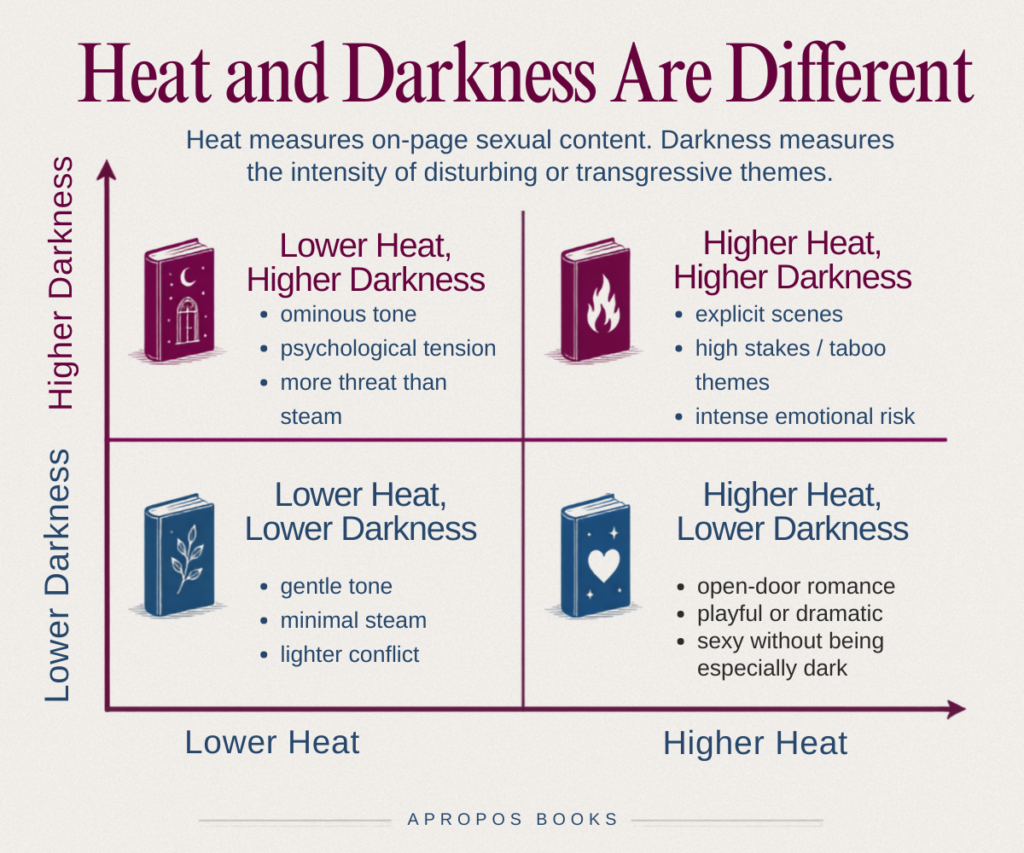
Darkness and heat are not the same measurement. Heat describes how explicit the sexual content is, while darkness describes the relationship dynamics, themes, or events surrounding the couple.
TL;DR: Dark romance is a romance subgenre where danger, taboo, power imbalance, obsession, or violence shapes the central relationship. Darkness and heat are separate. A book can be disturbing without being highly explicit, or explicit without being dark. Check its consent terms, content warnings, and ending expectations before reading.
What Is Dark Romance?
Dark romance places a central love story inside circumstances that would be dangerous, unhealthy, illegal, frightening, or deeply complicated in real life.
The relationship may involve obsession, manipulation, captivity, revenge, criminal power, coercion, or severe emotional imbalance. In other books, the couple may have clearer boundaries while violence, danger, or trauma surrounds them.
It still needs to function as romance. Romance Writers of America defines romance fiction around two essential elements: a central love story and an emotionally satisfying, optimistic ending.
The tone can be as dark as the author chooses, but the romantic relationship remains central. A thriller does not become dark romance because the detective and the suspected murderer have inconvenient chemistry.
Ready to see how those differences work in actual books? Browse our dark romance book recommendations next.
Where Does the Darkness Come From?
One of the most useful questions is whether the darkness occurs inside the relationship or outside it.
| Source of Darkness | What It May Include | What to Ask Before Reading |
|---|---|---|
| Inside the relationship | Stalking, coercion, captivity, manipulation, possessiveness, or dubious consent | Am I comfortable with these dynamics between the romantic leads? |
| Outside the relationship | Organized crime, murder, revenge, blackmail, war, or family violence | Do I want external danger with a more consensual central relationship? |
| Both | Criminal or violent danger combined with coercive or abusive romantic dynamics | How intense are both the relationship and the surrounding events? |
That distinction explains why the dark romance label alone is not enough information.
One reader may want mafia conflict and dangerous devotion but no nonconsensual sexual content. Another may deliberately seek a captor-captive story. Both are looking within the same broad subgenre, but they are not looking for the same book.
Is Dark Romance Always Spicy?
No. Dark romance is often explicit, but darkness and heat measure different things.
Heat describes how sexual content appears on the page. Darkness describes the story’s disturbing themes, power structures, violence, or relationship dynamics.
There is no universal heat scale used by every publisher, author, reviewer, and book platform. Many systems use some version of closed door, open door, explicit, and explicit-and-frequent categories.
Reader platforms such as Romance.io organize romance books by steam level, but readers should still check how each source defines its ratings.
A Reader-Friendly Heat Scale
| Level | Reader Expectation |
|---|---|
| One: Low heat | Kissing or attraction with no on-page sex |
| Two: Fade to black | Sex is implied, but the scene ends before explicit detail |
| Three: Open door | Sexual activity appears on the page with moderate detail |
| Four: Explicit | Detailed sexual scenes use direct language |
| Five: Explicit and frequent | Detailed scenes appear often and may be central to the relationship arc |
This scale is useful shorthand, not an official rating system. Check the definitions used by the author, publisher, reviewer, or platform supplying the rating.
Heat and Darkness Are Separate
A romance book can occupy any point on both scales.
- Low darkness and low heat may describe a gentle contemporary romance.
- Low darkness and high heat may describe explicit romance with clear consent.
- High darkness and low heat may focus on obsession, violence, or psychological control without frequent sex scenes.
- High darkness and high heat may combine explicit content with coercion, captivity, violence, or extreme power imbalance.
A flame rating cannot replace content notes. Five flames tell you how much appears on the page, not whether anyone has been kidnapped before dinner.
Readers primarily looking for explicit romance without darker relationship dynamics may be better matched with our spicy romance books.
What Content Warnings Are Common in Dark Romance?
Content warnings identify material that readers may want to know about before starting a book.
They are not ratings of literary quality, diagnoses of the characters, or judgments about the reader. The Book Trigger Warnings disclaimer similarly explains that identifying content does not make a judgment about the book or its author.
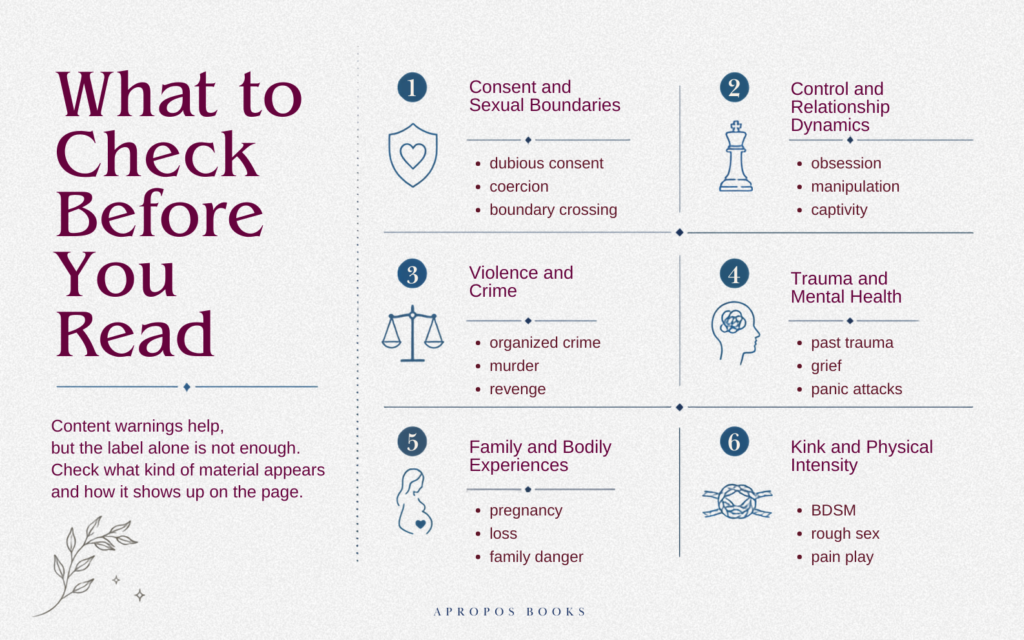
| Category | Possible Content Warnings |
|---|---|
| Consent and sexual boundaries | Dubious consent, nonconsent, sexual assault, consensual nonconsent, impaired consent, or reproductive coercion |
| Control and relationship dynamics | Stalking, kidnapping, captivity, emotional abuse, manipulation, blackmail, or humiliation |
| Violence and crime | Murder, torture, gore, weapons, trafficking, organized crime, or domestic violence |
| Trauma and mental health | Self-harm, suicide, addiction, grief, panic attacks, or trauma responses |
| Family and bodily experiences | Pregnancy, miscarriage, infertility, child loss, child abuse, eating disorders, or medical trauma |
| Kink and physical intensity | BDSM, degradation, breath restriction, blood play, knife play, or gun play |
A warning may tell you that a subject appears without explaining how central or graphic it is.
Stalking could describe a few unsettling scenes or the entire romantic premise. Violence could occur off-page, on-page, or in significant detail. Specificity matters.
Consent Terms Readers Should Know
- Dubcon
- Dubcon is short for dubious consent. It describes a situation where consent is unclear, pressured, compromised, or affected by an unequal power dynamic.
- Noncon
- Noncon is short for nonconsensual. It describes sexual activity that occurs without consent.
- CNC
- CNC is short for consensual nonconsent. It refers to an agreed-upon role-play or kink between consenting adults. The fictional scene may simulate force or resistance, but prior consent and negotiated boundaries distinguish CNC from nonconsent.
These labels are not interchangeable. A book that includes one may not include the others, which is why a description such as “dark themes” is rarely enough information by itself.
Where Should You Check Content Warnings?
Start with the author or publisher. Those sources are most likely to reflect the intended content notes for the book.
The StoryGraph uses author-added and user-submitted content warnings to help readers identify material they may prefer to avoid.
Book Trigger Warnings is a community-edited database that can provide additional information. Because community databases can be incomplete, they work best as an extra source rather than the only one.
A useful checking order is:
- Author or publisher content notes
- Author-added warnings on book platforms
- Community warning databases
- Spoiler-light reviews from readers you trust
When sources disagree, assume the more specific warning may be relevant until you can verify it.
Keep this guide handy when a book description gives you three flame icons and no useful explanation of what happens on the page.
What Tropes Appear in Dark Romance?
Dark romance can take place in contemporary, historical, paranormal, fantasy, college, criminal, or gothic settings.
Common tropes and subtypes include:
- Mafia and organized crime
- Stalking and obsession
- Captor-captive relationships
- Bully romance
- Secret societies
- Revenge romance
- Arranged marriage
- Forced proximity
- Villain romance
- Possessive protectors
- Why-choose relationships
- Enemies to lovers
A trope does not determine a book’s exact darkness level.
Two mafia romances may share criminal families and arranged relationships while treating consent, violence, and sexual content very differently. Readers looking specifically for criminal power struggles can explore our dark mafia romance books.
Readers drawn to dangerous devotion and fiercely protective love interests may also enjoy these touch-her-and-die romance books.
Does Dark Romance Have a Happy Ending?
Books sold as genre romance are generally expected to provide an emotionally satisfying and optimistic resolution to the central relationship.
That may be a traditional happily ever after or a happily for now. Romance Writers of America defines both around the main characters being rewarded for the risks and struggles they undertake for their relationship.
The organization’s Diamond Heart rules explicitly ask judges whether a romance has an HEA or HFN, reinforcing that an optimistic romantic resolution is part of the genre expectation.
Dark romance may stretch the definition of satisfying. The couple may remain dangerous, ethically compromised, or deeply unconventional. The ending does not have to turn them into model neighbors.
If the relationship ends in permanent separation, destruction, or tragedy without an optimistic romantic resolution, the book may fit dark fiction, romantic tragedy, psychological fiction, or another adjacent genre more closely.
Series structure can complicate this. One installment may end on a cliffhanger while the final book resolves the romance, so check whether the story follows one couple across multiple volumes.
How Is Dark Romance Different From Related Genres?
These categories can overlap, but they do not promise the same reading experience.
| Genre | Central Focus | Typical Source of Darkness | Romantic Ending Expected? |
|---|---|---|---|
| Dark romance | The central romantic relationship | The relationship, the characters, or surrounding danger | Generally yes |
| Romantic suspense | Romance combined with an external mystery or threat | Crime, pursuit, investigation, or danger | Generally yes |
| Erotic romance | Romantic development where explicit sex is integral | Sexual exploration, which may or may not be dark | Generally yes |
| Dark erotica | Sexual transgression, taboo, or intense erotic exploration | Power, kink, violence, or extreme scenarios | Not necessarily |
| Horror romance | Romance combined with fear or horror | Monsters, supernatural threats, gore, or survival | Depends on how the book is marketed |
| Dark fantasy romance | Romance within a dark fantasy setting | Magic, war, monsters, corruption, or the relationship | Usually, when sold as romance |
The simplest test is to ask what the book cannot function without.
If removing the love story collapses the main plot, it is probably romance. If removing the mystery, horror, or sexual exploration collapses the book while the relationship remains optional, another category may be doing more of the work.
Readers who prefer secrets, atmosphere, and emotional danger may want our gothic romance book recommendations.
Readers who want supernatural love interests and otherworldly threats can browse our paranormal romance books.
How Do You Choose the Right Dark Romance?
Start with the type of darkness you are willing to read, not the book’s flame rating.
- Identify whether the danger is inside or outside the relationship.
- Check the heat level separately.
- Read the complete content warnings.
- Look for precise consent terminology.
- Confirm whether the book has an HEA, HFN, or series cliffhanger.
- Read spoiler-light reviews when a warning is unclear.
Do not assume that a popular title is an easy entry point. A book going viral tells you that many people are discussing it. It does not tell you whether its content fits your boundaries.
The right starting book is the one whose heat, relationship dynamics, and warning profile match what you actually want to read.
Why Do Readers Choose Dark Romance?
For some readers, the appeal lies in emotional intensity, psychological tension, taboo curiosity, redemption, or fictional relationships that operate far outside ordinary life.
Reading about a dangerous relationship does not automatically mean someone wants or endorses that relationship in reality. Fiction allows readers to examine fears, desires, and uncomfortable ideas at a distance.
Dark romance is also broad enough to accommodate different boundaries. Some readers want criminal danger with clear consent. Others want the relationship itself to cross lines.
Neither preference can be predicted from the genre label alone. The content notes do the useful work.
Dark Romance FAQ
Is dark romance always about abuse?
No. Some dark romances place violence, crime, or danger outside the central relationship while giving the leads clearer consent and emotional boundaries.
Other books make coercion, control, or abuse part of the relationship itself. Check the individual book rather than relying on the genre label.
Is dark romance the same as taboo romance?
No. Taboo romance centers a relationship that violates a social, cultural, professional, or familial boundary.
It may be dark, but it does not have to include violence, coercion, criminal behavior, or psychological danger.
Is dark romance only for adults?
The label is not an official age rating, but many dark romance books are written and marketed for adults because they contain explicit sexual material, violence, abuse, or other mature subjects.
Check the publisher’s audience category instead of assuming a recommendation from social media is suitable for every age.
Are content warnings spoilers?
They can reveal broad categories of material, but well-written warnings do not need to disclose major plot outcomes.
Readers who prefer fewer details can look for spoiler-light notes that identify the subject and intensity without explaining when it occurs.
Is dark romance the same as erotica?
No. Dark romance requires a central romantic relationship and an optimistic romantic resolution.
Erotica centers sexual exploration and does not necessarily promise a lasting relationship or happy ending. A book can contain explicit sex without being either dark romance or erotica.
Can dark romance have low heat?
Yes. A dark romance can focus on obsession, crime, manipulation, psychological control, or violence while including little explicit sexual content.
Heat measures what appears sexually on the page. It does not determine how disturbing the story may be.
Choose the Version That Fits Your Reading Boundaries
Dark romance covers everything from criminal danger with consensual relationships to stories built around coercion, captivity, and crossed boundaries.
A compelling book can still be the wrong book for a particular reader. Checking the content notes is good reading judgment, not a failed test of nerve.
Want more romance recommendations? Join Apropos Books for daily eBook deals and choose Romance as one of your favorite genres.