Cozy fantasy keeps the magic, brings the stakes closer to home, and gives relationships, community, and everyday life room to matter.
Fantasy does not always need a kingdom on the verge of collapse. Sometimes the important question is whether someone can build a new life, keep a business open, find their people, or make a place feel like home.
That is where cozy fantasy lives. These stories can still contain danger, grief, romance, adventure, and difficult choices, but they spend more time on connection, restoration, and the smaller parts of life that other fantasy stories often rush past.
What Is Cozy Fantasy?
Cozy fantasy is fantasy focused on personal or local stakes, hopeful storytelling, relationships, community, and everyday life. It can include danger, romance, grief, or adventure, but the story usually returns to connection, safety, restoration, or belonging rather than constant world-ending conflict.
What Defines Cozy Fantasy?
Cozy fantasy uses the same building blocks as the rest of the genre. There may be witches, magical creatures, enchanted objects, strange worlds, spells, quests, or impossible places. The difference is what the story chooses to treat as important.
Instead of concentrating almost entirely on war, conquest, survival, or political power, cozy fantasy often brings the conflict closer to the characters themselves. A livelihood may be at risk. A friendship may be falling apart. Someone may need to start over, protect a community, or decide what kind of life they actually want.
That smaller scale gives ordinary experiences more room to matter. Meals, work, friendships, homes, hobbies, local traditions, and conversations can carry real narrative weight instead of serving only as pauses between battles.
The genre is also generally hopeful. That does not mean every character is happy or every problem disappears neatly. It means the story gives readers reasons to believe that connection, kindness, effort, and community can change something.
Fantasy author Sarah Beth Durst describes cozy fantasy in terms of the sense of sanctuary it offers readers. That idea is useful because it explains why a book can contain genuine conflict and still feel cozy.
What Makes a Fantasy Story Feel Cozy?
There is no official checklist that every cozy fantasy has to pass. Still, the clearest examples tend to share several traits.
Novelists, Inc. identifies personal stakes, community building, everyday uses of magic, welcoming settings, and sensory comfort among the recurring features of modern cozy fantasy.
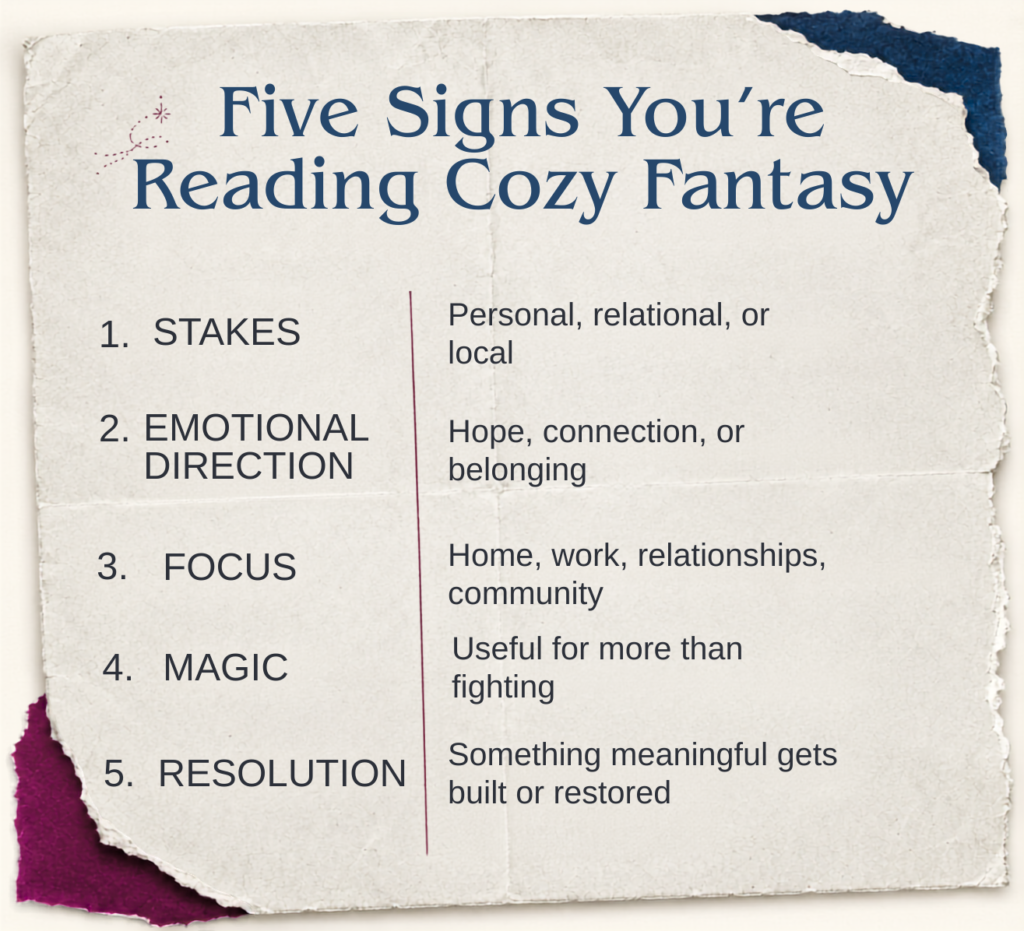
A useful way to think about the genre is through five parts of the reading experience.
| Element | Common Cozy Fantasy Signal | What Is Not Required |
|---|---|---|
| Stakes | Personal, relational, or community-sized problems | A complete absence of danger |
| Emotional direction | Hope, connection, restoration, or belonging | Constant happiness |
| Focus | Relationships, work, home, community, or everyday life | A story where nothing happens |
| Fantasy elements | Magic can create, nurture, solve problems, or shape daily life | Magic that is completely harmless |
| Resolution | A meaningful sense of progress, safety, or connection | Every problem wrapped up perfectly |
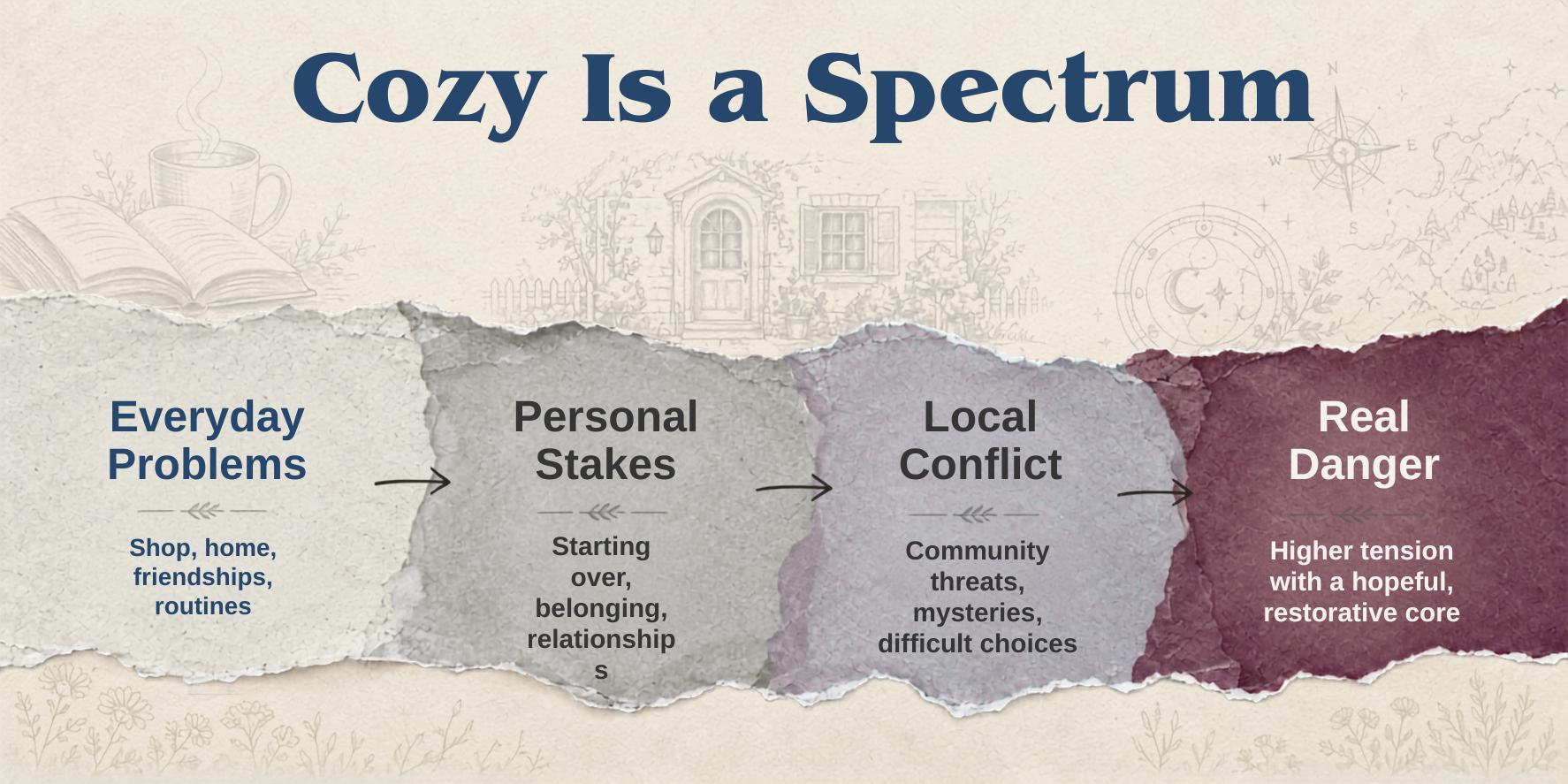
A book does not need every characteristic in equal measure. Cozy fantasy works more like a spectrum than a pass-or-fail test.
Some stories stay close to ordinary life from beginning to end. Others wander into much more dangerous territory before returning to their emotional center.
Does Cozy Fantasy Have to Be Low Stakes?
No. Low stakes are common in cozy fantasy, but they are not an absolute requirement.
The more useful distinction is often between personal stakes and relentlessly escalating stakes. Losing a home, a friendship, a livelihood, or a community can matter enormously to a character without putting an entire kingdom on the evacuation list.
A cozy fantasy can also contain serious danger. Characters may face violence, grief, prejudice, political instability, or threats to the people they love.
Those elements usually do not dominate the entire reading experience. The story continues making room for relationships, routines, humor, food, work, creativity, and places where characters feel grounded.
There is somewhere emotionally reassuring to return to after the difficult parts.
This is also why readers can reasonably disagree about whether the same book qualifies as cozy fantasy. Everyone has a different threshold for how much danger or tension still feels comfortable.
What Are the Most Common Cozy Fantasy Tropes?
Cozy fantasy has developed some very recognizable patterns. None is mandatory, but several tend to appear together.
- Found family
- Starting over somewhere new
- Small towns and close communities
- Magical shops, cafés, inns, libraries, and bakeries
- Practical or domestic uses of magic
- Unlikely friendships
- Restoring a home, business, or community
- Food and drink as social rituals
- Seasonal festivals and local traditions
- Magical creatures as companions or neighbors
- Community problems rather than world-ending threats
- Romance that develops alongside the larger story
The genre’s affection for cafés and bakeries is understandable. Give fantasy readers one talking cat and a pastry display and suddenly nobody cares who inherited the throne.
Still, a bakery does not make a book cozy by itself. The setting only matters when the story uses it to create the relationships, routines, community, and emotional experience associated with the genre.
Does Cozy Fantasy Need Romance?
No. Romance appears frequently in cozy fantasy, but a love story is not part of the definition.
Friendship, found family, community, mentorship, work, grief, identity, and personal growth can provide the emotional center instead. Readers who prefer their magic without a romantic subplot can find more options in our guide to fantasy books with no romance.
When romance is present, it can be central or secondary. Cozy fantasy describes the broader emotional and narrative experience, not the percentage of pages devoted to falling in love.
That also separates it from romantasy, where the fantasy story and central romantic arc both play an essential role in the main narrative. A book can be both cozy fantasy and romantasy, but neither label automatically guarantees the other.
Is Cozy Fantasy the Same as Cottagecore Fantasy?
No. Cozy fantasy and cottagecore fantasy overlap heavily, but they describe different things.
Cozy fantasy is primarily about the scale, emotional direction, and priorities of a story. Cottagecore fantasy is more strongly associated with pastoral settings, nature, traditional crafts, gardens, food, slower living, and life organized around home or a small community.
Our guide to cottagecore fantasy books focuses specifically on those nature-centered and slower-living elements. Many of those stories also qualify as cozy fantasy, which is where the categories meet.
Cozy fantasy is broader. It can take place in a city, castle, magical school, library, government office, island, inn, traveling home, or anywhere else a story can build that combination of personal stakes and emotional reassurance.
No cottage is required. The herb garden may stand down.
How Is Cozy Fantasy Different From Cozy Mystery?
Cozy fantasy and cozy mystery can feel similar because both often value community, recurring relationships, contained settings, and a less punishing reading experience.
The difference is what drives the story. Cozy mystery is structured around a mystery that needs to be solved. The genre traditionally keeps graphic violence and sexual content restrained while an amateur or community-connected sleuth investigates the crime.
Cozy fantasy does not need a mystery at all. Its central problem might involve starting a business, repairing a home, caring for magical creatures, navigating a community dispute, learning a craft, building friendships, or simply finding a satisfying way to live.
The two genres can overlap. A magical village with an amateur sleuth, an enchanted café, and a suspicious death could comfortably have a foot in both.
Is Cozy Fantasy the Same as Slice-of-Life Fantasy?
They are close relatives, but the terms are not interchangeable.
Slice-of-life describes a storytelling approach that gives significant attention to everyday experiences, routines, relationships, and smaller events. A slice-of-life fantasy might spend substantial time following what characters do when nobody is storming a castle.
Cozy fantasy usually adds an emotional expectation. Readers tend to expect hope, comfort, safety, belonging, restoration, or some combination of them.
A story can therefore be slice-of-life without feeling especially cozy. It can also be cozy while containing enough conventional plotting and adventure that calling it slice-of-life would not quite fit.
Where Did Cozy Fantasy Come From?
Comforting fantasy existed long before cozy fantasy became a recognizable publishing label.
Sarah Beth Durst points to Diana Wynne Jones’s Howl’s Moving Castle and Patricia C. Wrede’s Dealing with Dragons as older novels that could readily be described as cozy fantasy if they were published today. She places the emergence of the modern labeled subgenre around 2020 in her history of cozy fantasy.
TJ Klune’s The House in the Cerulean Sea, published in 2020, became closely associated with the kind of relationship-centered and emotionally reassuring fantasy that readers were beginning to identify as cozy.
Travis Baldree’s Legends & Lattes followed in 2022 and gave the genre one of its clearest modern premises: a retired adventurer opening a coffee shop instead of beginning another quest.
The label soon moved beyond online reader shorthand. Publishers Weekly reported that the trade paperback edition of Legends & Lattes had sold 258,000 copies, while its follow-up, Bookshops & Bonedust, had sold 133,000.
Newer cozy fantasy has expanded well beyond the coffee-shop model. The category now includes libraries, magical research, small businesses, wandering characters, strange households, romances, mysteries, creatures, schools, and stories that flirt with considerably more danger.
The genre keeps growing because its defining idea is flexible. The scale may be smaller, but the fantasy can still be imaginative, strange, funny, emotionally complicated, or ambitious.
Why Is Cozy Fantasy So Popular?
The easy explanation is that the world is stressful and readers want comforting books. That is part of it, but it does not fully explain why cozy fantasy has developed into a recognizable corner of publishing.
One reason is that cozy fantasy offers a different kind of narrative payoff.
Traditional epic fantasy often builds toward conquest, survival, war, political upheaval, or defeating an enormous threat. Cozy fantasy can spend that same narrative energy on building something.
A character opens a business. A neglected place becomes a home. Strangers become friends. A community starts functioning. Someone learns how to live differently after spending years convinced there was only one possible version of their life.
Those goals sound smaller on paper, but they create plenty of room for meaningful conflict. When there is no invading army available to keep every chapter moving, character decisions and relationships have to do more work.
A failed conversation, damaged friendship, threatened livelihood, or hard-earned act of trust can matter just as much as a larger fantasy spectacle. Small problems are still allowed to have big feelings.
Novelists, Inc. also connects the genre’s growth to readers seeking stories built around optimism, community, and active comfort rather than simply removing plot or complexity.
That distinction matters. Cozy fantasy is not fantasy with everything interesting taken out. It is fantasy choosing different things to treat as interesting.
Who Is Cozy Fantasy For?
Cozy fantasy can work especially well for readers who love imaginative worlds but do not always want the pressure dial turned all the way up.
- Readers who prefer personal stakes to constant world-saving
- Readers who care deeply about friendships and community
- Character-driven fantasy readers
- Readers who enjoy seeing how people actually live inside fantasy worlds
- Readers drawn to found family and starting-over stories
- Readers who like hopeful resolutions without requiring conflict-free plots
- Fantasy readers looking for something between larger, heavier series
If the part of an epic quest you always liked most was when everyone finally reached the inn, ate something hot, and talked to each other, there is an entire part of fantasy taking that preference seriously.
You can browse the Cozy Fantasy collection on Apropos Books to see how the genre stretches across different kinds of stories.
Or explore more fantasy book recommendations, including stories that have absolutely no intention of letting anyone enjoy an uninterrupted cup of tea.
Cozy Fantasy FAQ
Is cozy fantasy always low stakes?
No. Cozy fantasy often uses personal or local stakes instead of threats to an entire kingdom or world, but serious danger can still appear. The overall emotional experience and the story’s priorities matter as much as the size of an individual conflict.
Can cozy fantasy have violence?
Yes. Violence does not automatically make a book non-cozy. Graphic, relentless, or emotionally punishing violence is less typical, but some cozy fantasy includes fights, death, danger, or darker events while maintaining a hopeful and restorative core.
Does cozy fantasy have to take place in a small town?
No. Small towns, villages, inns, and shops are common because they make community-centered storytelling easy, but cozy fantasy can take place almost anywhere. The setting needs to support the story, not pass a cottage inspection.
Does cozy fantasy need a happy ending?
Cozy fantasy generally carries an expectation of hope or emotional reassurance, but that does not require every problem to disappear. A satisfying ending may involve belonging, recovery, a new beginning, restored relationships, or simply a character reaching a more hopeful place than where they started.
Is cozy fantasy only for adults?
No. Cozy fantasy can be written for adults, young adults, middle grade readers, or children. The genre describes the story’s fantasy elements and emotional approach rather than the age of its intended audience.
When You Want Magic Without a World to Save
Cozy fantasy makes room for human-sized stakes inside impossible worlds. A shop can matter. A friendship can matter. A meal, a home, a new beginning, or the decision to stay can matter.
Sometimes the dragon can stay off duty.
Looking for more fantasy without searching the same shelves again? Choose your favorite genres and get daily eBook deals from Apropos Books.