Romance Heat Levels Guide: From Clean to Explicit
A simple guide to low heat, closed door, open door, spicy, steamy, and explicit romance so you know what you’re getting before page one.
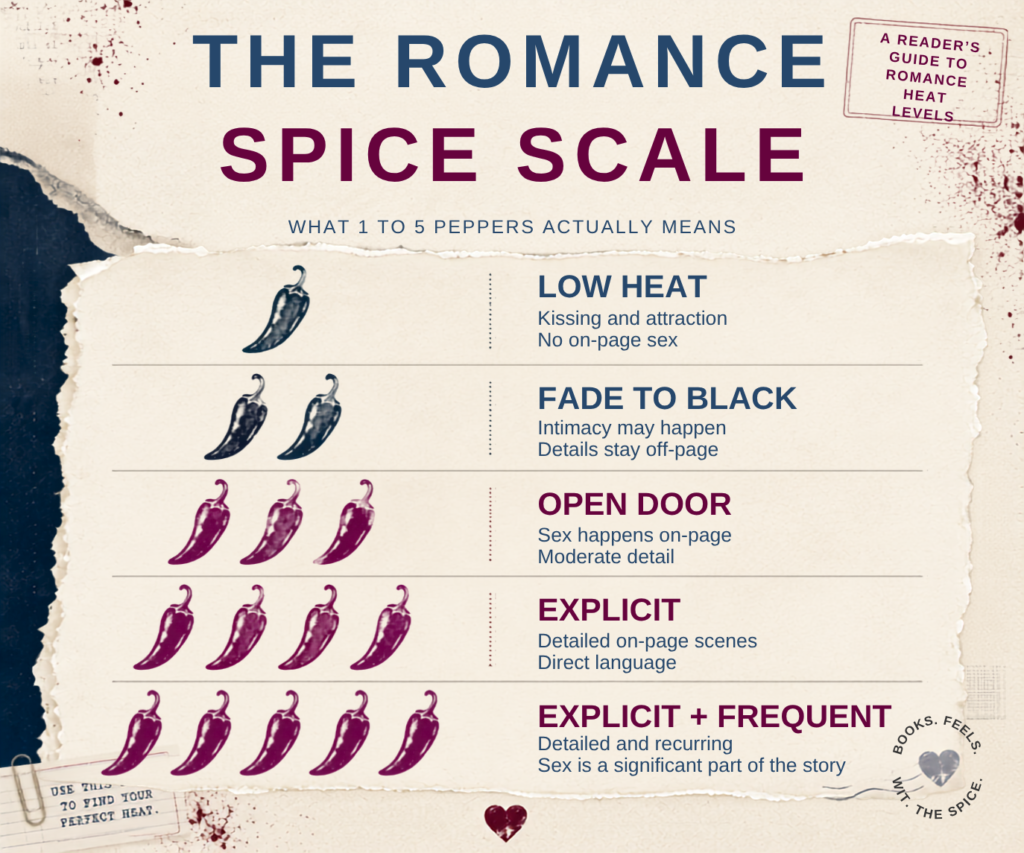
Romance heat levels describe how much sexual intimacy appears on the page and how explicitly it’s written. There isn’t one universal rating system, so Apropos Books uses five levels: low heat, fade to black, open door, explicit, and explicit and frequent.
The number isn’t a quality score. It’s simply a shortcut for answering a very practical reading question: exactly how open is this fictional bedroom door?
Romance heat levels are shorthand for how much sexual intimacy appears on the page and how explicitly it’s described. Apropos uses five levels: low heat, fade to black, open door, explicit, and explicit and frequent. Because heat ratings aren’t standardized, always check how a particular site or reviewer defines its scale.
What Are Romance Heat Levels?
A romance heat level tells you how sexual intimacy is handled in a book. It can indicate whether intimacy stays off-page, appears on-page, uses explicit language, or becomes a frequent part of the relationship.
Heat doesn’t determine whether a book qualifies as romance. According to Romance Writers of America, genre romance is built around a central love story and an emotionally satisfying, optimistic ending. Romance can range widely in sensuality, from sweet to extremely hot.
It also doesn’t tell you whether the couple has good chemistry. Two characters can create more tension while exchanging one extremely loaded glance across a ballroom than another pair manages during several fully documented evenings.
Heat measures what happens on the page. Chemistry is another matter entirely.
The Five Romance Heat Levels
Apropos Books uses a five-level scale so the same terminology can mean the same thing across our Romance guides. The scale is similar to the five-tier framework used by Romance.io, which moves from glimpses and kisses through explicit and plentiful sexual content.
| Level | Apropos Label | Common Labels | What to Expect |
|---|---|---|---|
| One | Low Heat | Clean, wholesome, chaste, glimpses and kisses | Attraction and kissing may appear, but no on-page sex |
| Two | Fade to Black | Closed door, behind closed doors | Sexual intimacy may happen, but the scene cuts away or remains off-page |
| Three | Open Door | Open door, moderate steam | Sexual intimacy appears on-page with some detail |
| Four | Explicit | Explicit open door, spicy, high heat | Detailed sexual scenes with direct language |
| Five | Explicit and Frequent | Very spicy, high heat, sometimes erotic romance | Multiple detailed scenes, with sexual intimacy playing a significant role in the relationship |
The important part is consistency. If Apropos calls something Level Four on one page, Level Four should mean the same thing everywhere else.
Level One: Low Heat
Level One romance keeps sexual content off the page entirely. Attraction, flirting, longing, hugs, and kissing can still be present, but sexual intimacy isn’t depicted on-page.
You may see these books described as clean, wholesome, chaste, sweet, or simply low heat. Those terms aren’t perfectly interchangeable, which we’ll get into shortly.
For a concrete example, Sariah Wilson’s Roommaid is rated 1 out of 5 for steam by Romance.io, using its glimpses-and-kisses designation.
And no, low heat doesn’t automatically mean low romantic tension. Sometimes not touching is doing an alarming amount of work.
Level Two: Fade to Black
At Level Two, the characters may have sex, but the reader doesn’t stay in the room.
The story might cut away as intimacy begins, imply what happened between scenes, or return the next morning. This is where terms such as closed door, behind closed doors, and fade to black usually appear.
Mimi Matthews’ The Work of Art is rated 2 out of 5 and behind closed doors by Romance.io.
The key difference from Level One is simple. At Level One, sexual intimacy generally isn’t shown or implied as part of the relationship on-page. At Level Two, it may happen, but the details remain private.
Respectful. Discreet. The fictional bedroom has excellent boundaries.
Level Three: Open Door
Level Three means sexual intimacy happens on-page.
The reader remains in the scene, but the description usually stays less graphic than it would at the higher levels. Language may be softer or less detailed, and the book may contain only one or a few intimate scenes.
Abby Jimenez’s Yours Truly is rated 3 out of 5 and open door by Romance.io.
This is an important middle ground because open door answers one question only: do we see the scene?
It doesn’t automatically tell us how long the scene lasts, how descriptive the language becomes, or how often it happens.
Level Four: Explicit
Level Four keeps the door open and gets much more specific.
Sexual scenes use clearer, more direct language. The physical action is described in greater detail, and there may be several intimate scenes across the book.
Tessa Bailey’s It Happened One Summer is rated 4 out of 5 and explicit open door by Romance.io.
This is the range many readers mean when they casually say a book is spicy. If that’s the side of the scale you prefer, our spicy romance books guide focuses specifically on romances that commit to on-page heat.
Unfortunately, spicy has never signed a contract agreeing to mean anything specific, so your mileage may vary.
Level Five: Explicit and Frequent
Level Five means explicit intimacy is both detailed and frequent.
There may be numerous sexual scenes, a wider range of sexual activities, or a relationship where sexual exploration plays a substantial role in character and relationship development.
Sara Cate’s Praise is rated 5 out of 5 and explicit and plentiful by Romance.io.
Some Level Five books may qualify as erotic romance, but high heat alone doesn’t automatically turn a romance novel into erotica.
That distinction matters.
Do Clean, Sweet, and Closed Door Mean the Same Thing?
No. They’re often used near each other, but they aren’t reliable synonyms.
Closed door tells you something fairly specific about how sexual intimacy is presented. It happens off-page, is only implied, or the story fades before the details begin. Modern Mrs Darcy’s heat-level definitions similarly distinguish chaste romance from closed-door romance and open-door romance.
Clean is less precise. Some readers and publishers use it simply to mean no explicit sexual content. Others may use it for books that also limit profanity, violence, substance use, or other mature material.
The term can also be uncomfortable for some romance readers and writers because describing one book as clean can imply that books containing sexual content are somehow dirty.
Sweet is just as difficult to use as a reliable rating. It can describe low sexual content, but it can also describe the emotional tone of a romance that contains on-page sex.
For that reason, Apropos favors concrete descriptions such as low heat, fade to black, closed door, open door, explicit, and explicit and frequent.
You shouldn’t need a decoder ring to figure out whether you’re reading a sex scene.
What Does 3 Out of 5 Spice Mean?
On the Apropos heat scale, 3 out of 5 means open-door romance.
At least some sexual intimacy happens on the page. The reader remains in the scene, but the language and frequency are generally more moderate than Levels Four and Five.
The five-level Romance.io steam system uses the same basic dividing point, with Level Three labeled open door, followed by explicit open door at Level Four and explicit and plentiful at Level Five.
That makes Level Three a useful line in the sand.
- Levels One and Two keep sexual intimacy off-page.
- Levels Three through Five put at least some sexual intimacy on-page.
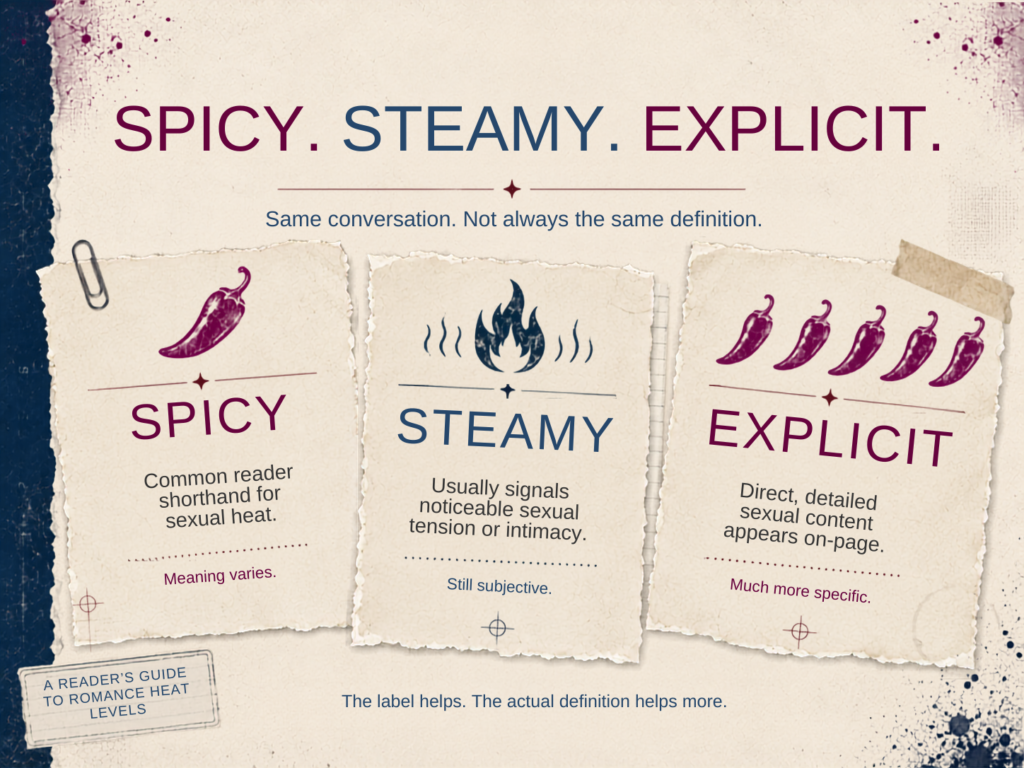
What Do Spicy and Steamy Mean in Romance?
They don’t tell you enough unless the person using them explains the scale.
Spicy and steamy are common reader shorthand for sexual content, but heat levels are subjective. One reader’s moderate romance can easily be another reader’s very spicy book.
A more useful rating answers three questions:
- Does sexual intimacy appear on-page?
- How explicitly is it described?
- How frequently does it appear?
Those details give you considerably more information than a row of chili peppers with no instructions.
Is Erotic Romance the Same as Erotica?
No.
Erotic romance is still romance. Romance Writers of America defines erotic romance as romance in which strong, often explicit sexual interaction is an inherent part of the love story, character growth, and relationship development.
That means the central romance still matters. The emotional relationship and romantic resolution remain fundamental to the story.
Erotica is a different category. Sexual exploration may be the central focus, and it doesn’t require the same central love story or optimistic romantic ending expected of genre romance.
So a Level Five book can absolutely still be a romance novel.
There just happens to be considerably less concern about closing the door.
What a Heat Level Does Not Tell You
Heat is only one piece of information about a romance.
A Level Five rating doesn’t automatically mean a book contains BDSM, taboo relationships, violence, coercion, dark romance themes, or any particular sexual activity.
Likewise, a Level One book isn’t automatically free of violence, grief, trauma, profanity, substance use, religious themes, or other potentially sensitive content.
We make the same distinction in our guide to what dark romance is. Darkness and heat measure different things. A romance can be very dark with relatively little sexual content, or highly explicit without being dark.
Content warnings answer, “What happens in this book?”
Heat answers, “How much sexual intimacy do I see?”
Keep both questions.
Can an Author’s Heat Level Change Between Books?
Absolutely.
This is why author names are useful examples, but poor permanent classifications. An author can write across several heat levels, and individual books should be rated on their own.
Sariah Wilson is a good example. Roommaid sits at Level One on Romance.io, while #Starstruck is rated Level Two.
Abby Jimenez also varies. Worst Wingman Ever is rated Level One, while novels including Yours Truly, Part of Your World, and Just for the Summer sit at Level Three.
So “I’ve read this author before” is useful information.
“I therefore know exactly how spicy everything they’ve ever written will be” is considerably less dependable.
Check the book.
How Do You Choose the Right Romance Heat Level?
Start with one question: do you want sexual intimacy on the page?
If the answer is no, start with Levels One and Two. Level One generally keeps sex out of the story, while Level Two allows intimacy to happen without showing the details.
If the answer is yes, Levels Three through Five give you progressively more detail and frequency.
Then check content notes separately. Heat level can help you find the amount of sexual content you prefer, but it isn’t a substitute for knowing what themes, relationship dynamics, or other material appears in the book.
And there’s no correct heat preference.
You are allowed to want 400 pages of longing and one kiss.
You are also allowed to wonder why everyone is still wearing clothes on page 86.
Romance contains room for both.
Romance Heat Levels FAQ
Is a romance heat level the same as an age rating?
No. A heat level describes sexual intimacy, not the recommended age for a book. Audience category, violence, language, substance use, and other mature content are separate considerations.
Does a higher heat rating mean a romance has better chemistry?
No. Heat describes how intimacy appears on the page. Romantic chemistry can be strong or weak at any heat level.
Can the heat level change within a romance series?
Yes. Some series remain consistent while others become more or less explicit as the books progress or different couples take the lead. Check individual titles when heat level matters to you.
Do heat ratings include content warnings?
No. Heat ratings focus on sexual intimacy. Violence, abuse, coercion, grief, substance use, and other sensitive material should be covered separately in content notes or warnings.
Why do different sites give the same romance different spice ratings?
Because romance heat ratings aren’t standardized. Readers, authors, reviewers, publishers, and book databases may weigh explicitness, frequency, language, and sexual activity differently.
Read at the Temperature You Actually Like
Romance has plenty of room between one significant glance and a bedroom door that has apparently been removed from its hinges.
Knowing the heat level simply helps you choose deliberately.
If you’d like to put the scale to use, start with our spicy romance recommendations and find the level that works for you.
More Romance Guides
- Fake Dating Romance Books
- Historical Romance Books
- Enemies to Lovers Books
- Paranormal Romance Books
- Dark Romance Books
Want romance eBook deals matched to the genres you actually read? Choose your favorite genres and get daily eBook deals from Apropos Books.